
EMERALD-3研究中曲美木单抗+度伐利尤单抗±仑伐替尼联合TACE,这种多模式治疗对HCC患者的肝功能会产生怎样的影响?与单纯TACE或其他联合方案相比,双免+靶向+TACE在肝功能保护方面表现如何?
Masatoshi Kudo 教授
在EMERALD-3研究中,我们对患者的肝功能变化趋势进行了评估。研究共设置三个治疗组:STRIDE方案(曲美木单抗+度伐利尤单抗)联合仑伐替尼+TACE组、STRIDE方案联合TACE组、单纯TACE组。我们动态观察治疗全程的肝功能变化,并按照ALBI分级、Child-Pugh评分对基线肝功能进行分层,分层包含ALBI 1级、ALBI 2级、Child-Pugh 5分及Child-Pugh 6分人群。三组患者的肝功能变化未见显著组间差异。
即使在基线肝功能较差的ALBI 2级亚组中,包含STRIDE的联合方案(STRIDE+仑伐替尼+TACE、STRIDE+TACE)也均未造成患者肝功能恶化。需要注意的是,单纯TACE组的治疗持续时间短于另外两组。在Child-Pugh 5分或6分的患者中也观察到相似趋势。因此,即便是基线肝功能存在损伤的患者,以双免疫检查点抑制剂为基础联合TACE的方案并不会诱发肝功能恶化。
Q:How does this multimodal regimen of tremelimumab plus durvalumab with or without lenvatinib combined with TACE affect the liver function of patients with HCC? Compared with TACE monotherapy or other combination regimens, what is the performance of dual immunotherapy plus targeted therapy plus TACE in terms of liver function preservation?
Prof. Masatoshi Kudo: In EMERALD-3, we evaluated the trajectory of liver function. Specifically, there were three treatment arms: STRIDE (STRIDE regimen :[tremelimumab plus durvalumab])plus lenvatinib plus TACE, STRIDE plus TACE, and TACE alone. We assessed liver function changes over the treatment period, with baseline liver function stratified by ALBI grade and Child-Pugh score, including ALBI grade 1, ALBI grade 2, Child Pugh score 5 and Child Pugh score 6. No significant differences were observed across the three treatment arms.
Even in the subgroup with baseline ALBI grade 2, representing patients with poorer liver function, liver function did not deteriorate by the STRIDE-containing regimens, including STRIDE plus lenvatinib plus TACE and STRIDE plus TACE. It should be noted that the treatment duration in the TACE-only arm was shorter than that of the other two regimens. A similar trend was also seen in patients with Child-Pugh score 5 or 6. Therefore, even among patients with impaired baseline liver function, the dual immune checkpoint inhibitor-based combinations plus TACE did not lead to liver function deterioration.
Masatoshi Kudo 教授
患者经双免疫+仑伐替尼+TACE、双免疫+TACE或单纯TACE治疗进展后,后续治疗手段主要包含系统治疗(免疫检查点抑制剂、靶向药物)以及局部治疗。ALBI 1级与ALBI 2级患者可选择的后续治疗方案大体相近。
单纯TACE组疾病进展后,后续采用免疫治疗的比例更高;与之相对,经STRIDE+仑伐替尼+TACE方案治疗进展的患者,后续再使用靶向治疗的比例更低。单纯TACE治疗后进展的患者,可选择的系统治疗方案较多,例如阿替利珠单抗联合贝伐珠单抗,或其他免疫检查点抑制剂联合酪氨酸激酶抑制剂(TKI)方案。对于采用STRIDE为基础方案(双免疫联合TACE)一线治疗后进展的患者,一线STRIDE方案本身不含抗血管生成药物,因此仑伐替尼等抗VEGF药物或其他酪氨酸激酶抑制剂是合理的后线选择。
Q:This presentation specifically focuses on post-progression outcomes. What is the subsequent treatment landscape for patients who experience disease progression after receiving tremelimumab plus durvalumab ± lenvatinib combined with TACE? Does liver function status at progression influence the selection of second-line therapy? What would you recommend as the preferred next-line regimen for these patients?
Prof. Masatoshi Kudo:After progression following dual immunotherapy plus lenvatinib plus TACE, dual immunotherapy plus TACE, or TACE alone, subsequent therapies mainly consisted of systemic treatments including immune checkpoint inhibitors, targeted agents, and locoregional therapies. Similar subsequent treatment options were administered for patients with ALBI grade 1 and ALBI grade 2.
Following progression in the TACE-only arm, subsequent immunotherapy was applied more frequently. In contrast, after STRIDE plus lenvatinib plus TACE, subsequent targeted therapy was less commonly used. For patients progressing after TACE alone, a wide range of systemic therapies can be considered, such as atezolizumab plus bevacizumab or other immune checkpoint inhibitor plus TKI combinations. For patients progressing after STRIDE-based regimens (dual immunotherapy plus TACE), anti-VEGF agents such as lenvatinib or other TKIs are reasonable options, because no anti VEGF agent was incorporated in the first line STRIDE backbone.
EMERALD-3主要入组人群的病因谱如何?日本HCC以丙肝为主,而中国HCC以乙肝为主,且肝硬化背景、肿瘤分期分布存在差异。您认为该研究结果对中国乙肝相关HCC患者的外推性如何?
Masatoshi Kudo 教授
EMERALD-3研究的入组对象为eeHCC患者。研究初期按照1:1:1比例随机分组,分为STRIDE+仑伐替尼+TACE组、STRIDE+TACE组、单纯TACE组,该阶段共入组至多175例患者;在该队列之后,仅继续对A组(STRIDE+TACE)与C组(单纯TACE)进行随机化,直至两组各入组约275例受试者。
在前175例受试者队列中,中国患者占比更高,因此该早期队列中HBV相关肝细胞癌的比例更高;后续入组受试者更多来自其他地区。对前175例患者的分析结果显示:相较于单纯TACE,STRIDE+仑伐替尼+TACE方案可显著改善总生存期;STRIDE双免疫联合TACE方案的总生存同样优于单纯TACE。该结果提示,在中国占主导的HBV相关肝细胞癌人群中,上述联合方案同样能够带来生存获益。
Q:What is the etiology profile of the enrolled population in EMERALD-3 HCC in Japan is predominantly HCV-related, while HCC in China is mostly HBV-related, with discrepancies in underlying cirrhosis and tumor stage distribution. How do you evaluate the generalizability of these study findings to Chinese patients with HBV-associated HCC?
Prof. Masatoshi Kudo:In the EMERALD-3 trial, patients eligible for embolization were initially randomized in a 1:1:1 ratio to STRIDE plus lenvatinib plus TACE, STRIDE plus TACE, or TACE alone, up to 175 patients. After this cohort, randomization continued only for Arm A (STRIDE plus TACE) and Arm C (TACE alone), until approximately 275 participants were enrolled in each of these two groups.
More Chinese patients were recruited in the first 175-subject cohort, which meant a higher proportion of HBV-related HCC in this early set. Subsequent enrolment included more patients from other regions. Analysis of the first 175 patients demonstrated that STRIDE plus lenvatinib plus TACE achieved significantly better OS compared with TACE alone; STRIDE dual immunotherapy plus TACE also showed superior OS versus TACE alone. This finding suggests that patients with HBV-related HCC, which is predominant in Chinese populations, can derive benefit from these regimens.
研究一览
中文标题:Ⅲ期EMERALD-3研究:eeHCC患者接受曲美木单抗(T)+度伐利尤单抗(D)±仑伐替尼(L)+经动脉化疗栓塞(TACE)治疗的肝功能变化趋势及进展后结局
摘要号:LBA48
研究背景
EMERALD-3研究已达到主要研究终点。相较于单纯TACE,STRIDE±仑伐替尼+TACE方案呈现出可观的OS获益趋势。维持良好的肝功能,有助于患者在疾病进展后接受后续治疗。本文报道基于基线肝功能分层,开展的肝功能动态变化与临床结局的事后探索性分析。
研究方法
年龄≥18岁的eeHCC患者按1:1:1的比例随机分组,分别接受STRIDE治疗(第1天给予T 300 mg+D 1500 mg,之后每4周给予D 1500 mg)+L(每日8或12 mg)+TACE;STRIDE+TACE;或单纯TACE治疗,直至每组达到175例患者;之后调整为1:1随机,直至STRIDE+TACE组与单纯TACE组各入组约275例。患者按地区、既往姑息性栓塞治疗史和基线肿瘤负荷进行分层。主要终点为STRIDE+L+TACE治疗组与TACE治疗组的无进展生存期(PFS)。关键次要终点为STRIDE+L+TACE治疗组与TACE治疗组的OS;以及STRIDE+TACE治疗组与TACE治疗组的PFS和OS。PFS2为次要终点(图1)。
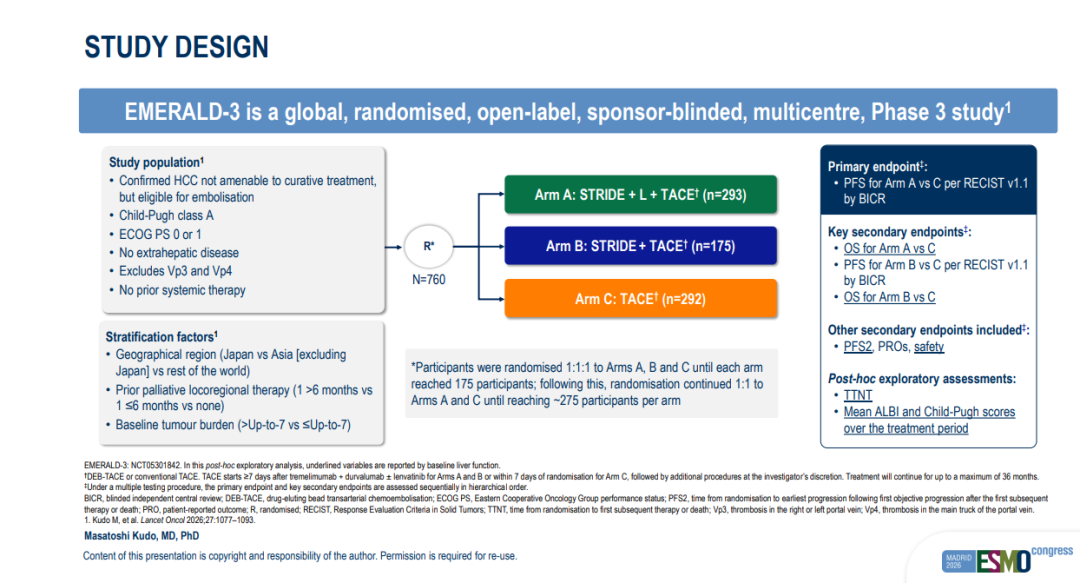
图1. 研究设计
研究结果
截至2026年2月23日,在SAS分析中,各基线分级(BL分级)患者的平均ALBI评分和Child-Pugh评分在治疗期间保持稳定。
在FAS分析中,ALBI 1级患者中,STRIDE+L+TACE治疗组的中位OS为44.6个月(95%CI:39.5~NC),而TACE治疗组为39.2个月(95%CI:34.7~NC)(HR=0.86[95%CI:0.60~1.22])。在ALBI 2级患者中,STRIDE+TACE组的中位OS为28.5个月(95%CI:20.7~34.3),而TACE组为22.1个月(95%CI:17.4~33.3)(HR=0.88[95%CI:0.60~1.28])(图2)。
ALBI 1级患者中,STRIDE+TACE组的中位OS为NC(95%CI:37.8~NC),而TACE组为39.2个月(95%CI:28.0~NC)(HR=0.57[95%CI:0.36~0.90]);ALBI 2级患者中,STRIDE+TACE组的中位OS为27.9个月(95%CI:17.8~NC),而TACE组为20.4个月(95%CI:16.6~30.1)(HR=0.81[95%CI:0.52~1.26])(图3)。
在所有基线分组中,STRIDE±L+TACE在数值上均优于TACE组。进展后接受后续治疗的比例在FAS组(ALBI 1级)为43%,在STRIDE+L+TACE组(ALBI 2级)为46%;在STRIDE+TACE组中分别为50%和53%;在TACE组中分别为72%和68%。各基线组间3/4级TRAE最大发生率相似。
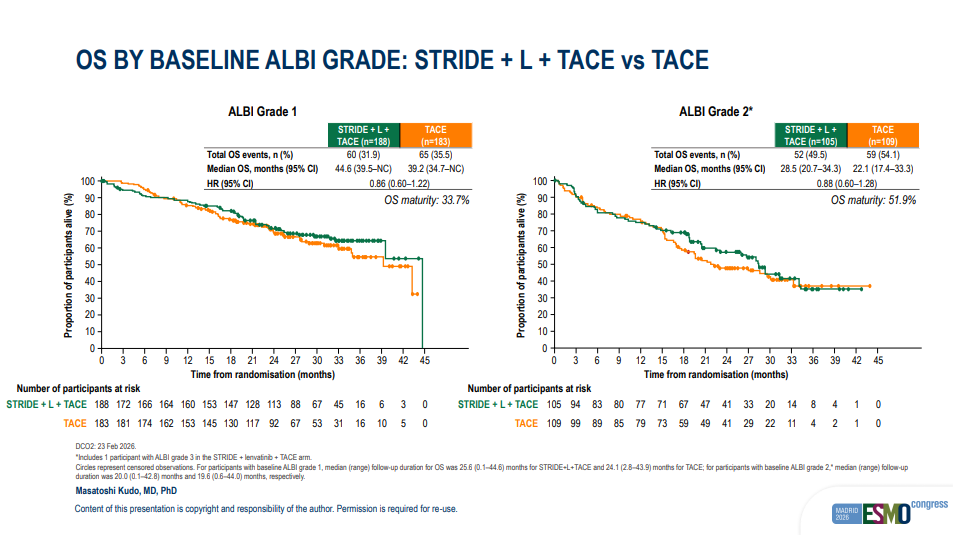
图2. STRIDE+L+TACE vs. TACE OS结果
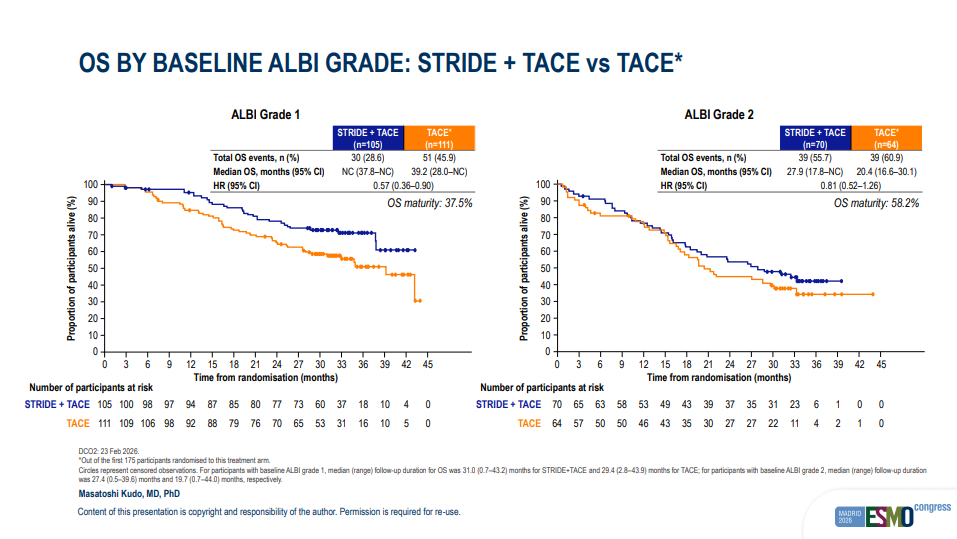
图3. STRIDE+TACE vs. TACE OS结果
研究结论
与单纯TACE相比,STRIDE±仑伐替尼联合TACE在进展后结局和生存结局上呈现出有临床意义的改善;无论基线肝功能分层如何,患者治疗期间肝功能稳定、安全性相当。该结果支持以STRIDE为基础的方案联合TACE,作为eeHCC患者潜在的全新治疗选择。

Masatoshi Kudo 教授
日本近畿大学医学院胃肠病学和肝脏病学系主任
国际肝癌协会(ILCA)创始理事、理事
亚太原发性肝癌专家(APPLE)会议主席(2015-2017)
美国肝脏疾病研究协会(AASLD)肝胆恶性肿瘤特别兴趣小组指导委员会成员
日本肝癌指南编委会主席
Liver Cancer杂志主编
参考文献:[1] Masatoshi Kudo, et al. 2026 ESMO. Abstract LBA48.
声明:本文仅供医疗卫生专业人士了解最新医药资讯参考使用,不代表本平台观点。该等信息不能以任何方式取代专业的医疗指导,也不应被视为诊疗建议,如果该信息被用于资讯以外的目的,本站及作者不承担相关责任。