AZUR-1研究显示,多塔利单抗单药即可实现76%的cCR12+pCR复合缓解率,且获得缓解的患者暂未观察到复发,证实该保器官方案可在不同诊疗中心稳定复制。本次ESMO会议期间,《肿瘤瞭望消化时讯》有幸邀请到AZUR-1研究主要讲者美国纪念斯隆凯瑟琳癌症中心Andrea Cercek教授,围绕研究核心数据、cCR患者长期无手术维持比例、等待观察策略落地瓶颈、ctDNA等生物标志物价值、未来研究方向以及距离指南改写还有哪些关键探索,展开深度对话。以下为访谈精粹。
2022年您团队在NEJM报告的多塔利单抗(Dostarlimab)单药治疗dMMR LARC,随访期间达到了100%临床完全缓解,当时引起全球轰动。AZUR-1作为全球多中心注册试验,首批结果的cCR率是多少?您如何评价这四年间"dMMR直肠癌器官保留"从个案走向标准的历程?
Andrea Cercek 教授
AZUR-1研究证实,多塔利单抗单药治疗错配修复缺陷(dMMR)局部晚期直肠癌具备可行性,单药方案即可获得较高的完全缓解率。研究数据显示,71%的患者达到临床完全缓解(cCR),另有5%患者在接受手术切除后证实为病理完全缓解(pCR),总体完全缓解率(cCR+pCR)达76%,提示这部分患者或可免于手术。
最令人振奋的一点在于:该研究证明这一治疗策略可在MSK(纪念斯隆凯特琳癌症中心)以外的中心复制。MSK中心在直肠癌非手术管理方面已积累成熟经验,中心内多学科诊疗团队对“等待观察”策略及严密随访方案十分熟悉。而该研究提示,即便在全球其他不以该模式作为直肠癌主流诊疗方案的中心,同样可以实现如此高比例的非手术管理。
Q: Your team’s 2022 NEJM report of single-agent dostarlimab for dMMR locally advanced rectal cancer, with 100% clinical complete response during follow-up, drew worldwide attention. As a global multicenter registrational trial, what is the cCR rate reported in the first results of AZUR-1? How would you reflect on this four-year journey, in which organ preservation for dMMR rectal cancer has evolved from an exploratory observation toward a potential standard-of-care approach?
Prof. Andrea Cercek:The AZUR-1 study demonstrated that dostarlimab monotherapy is feasible for dMMR locally advanced rectal cancer and yields high complete response rates with single-agent treatment alone. Data showed 71% of patients attained a clinical complete response,and an additional 5% reached a pathologic complete response upon surgical resection, bringing the overall CR(cCR+pCR) rate to 76%, suggesting these patients could have avoided surgery.
And I think this is the most exciting part: this study demonstrates that this treatment approach translates beyond a single academic center, Memorial Sloan Kettering, where we have well-established experience with non-operative management for rectal cancer.The entire disease management team at our center is very familiar with the watch-and-wait strategy and rigorous surveillance protocols.Yet this study shows that such high rates of non-operative management can be achieved at other centers worldwide, where rectal cancer care may not primarily center on this approach.
临床医生最关心的是"cCR之后能不能一直不做手术"。从首批数据来看,达到cCR的患者中,经过一段时间随访后维持无病状态、真正实现"免除手术"的比例是多少?有没有出现局部复发或远处转移的患者?
Andrea Cercek 教授
AZUR-1研究清晰凸显出一项核心挑战:cCR的判读难度较高。疗效评估需采用多模态综合手段,结合内镜、磁共振成像(MRI)、直肠指检以及患者症状状态共同判定。我们观察到,黏液腺癌病灶的MRI评估尤为困难。
这有赖于临床经验的不断积累;针对新型疗效终点,必然存在学习曲线。既往我们的核心治疗目标是实现根治性疾病控制,而保留原发灶、不实施放疗或手术切除的诊疗模式,在理念层面带来了新的挑战。本研究数据(尤其来自接受手术切除患者的结果)提示,其中部分患者或许无需接受手术,甚至可能不需要标准治疗方案中的放疗与化疗。
因此,标准化的疗效评估本身存在学习曲线。内镜联合MRI的评估结果,必须结合患者整体临床情况综合解读。随着经验积累,临床医生对等待观察策略的把握将更有信心。这一点对于接受多塔利单抗免疫治疗的MSI-H患者尤为重要,该人群的治疗应答往往存在延迟效应。
Q:A key concern for practicing clinicians is whether patients can safely avoid surgery after achieving cCR. Based on the initial AZUR-1 data, among patients who attained cCR, what proportion remain disease-free on surveillance and successfully avoid radical resection? Have any cases of local recurrence or distant metastasis been observed?
Prof. Andrea Cercek:I think one of the challenges, which was clearly demonstrated in AZUR-1 is that it is difficult to interpret clinical complete response.Assessment requires multimodal evaluation incorporating endoscopy, MRI, digital rectal examination, as well as patient symptom status.We observed that particularly the MRIs in mucinous tumors are very difficult to assess.This requires an accumulation of clinical experience. There is invariably a learning curve associated with novel therapeutic endpoints. The paradigm of retaining the primary tumor without radiotherapy or surgical resection poses a conceptual challenge, given our longstanding primary goal of achieving curative disease control. Our data, especially from patients who underwent surgical resection, suggest that a subset of these individuals may not have required surgical intervention, and possibly also the radiotherapy and chemotherapy administered as standard-of-care treatment.
Accordingly, a learning curve exists for standardized response evaluation. Assessments combining endoscopy and MRI must be contextualized within the overall clinical profile of individual patients, and clinicians will gain greater confidence in watch-and-wait strategies over time. This is particularly relevant for MSI-H patients receiving dostarlimab-based immunotherapy, in whom therapeutic responses may develop with delayed kinetics.
Andrea Cercek 教授
展望未来,dMMR直肠癌领域一项核心研究方向,是进一步完善临床完全缓解的评估手段。在我看来,多塔利单抗单药PD-1抑制治疗已具备充足疗效,无需采用联合方案。AZUR-1研究以及纪念斯隆凯特琳癌症中心的单中心研究数据均支持这一观点:该类患者无需接受放疗。
因此,未来的突破方向或将聚焦于优化评估手段,循环肿瘤DNA(ctDNA)即是其中之一。我们与Haystack Oncology开展的合作研究证实,ctDNA可为临床完全缓解评估提供极具价值的参考信息:所有达到临床完全缓解的患者,在治疗结束评估节点均实现ctDNA清零。优化评估体系、开发ctDNA等新型生物标志物、提升MRI影像判读能力,以及熟练掌握等待观察策略、给足肿瘤应答时间,是dMMR直肠癌领域接下来的重点工作。
此外,尚有一个关键科学问题有待解答:为何dMMR直肠癌的治疗应答显著优于消化道近端的dMMR肿瘤,后者的应答水平往往更有限。这种差异可能和肿瘤微环境、淋巴结受累模式,或是消化道近端病灶的免疫应答延迟有关。阐明该背后机制是重要的研究方向,有望推动非手术管理策略在全部dMMR实体瘤患者中更广范地落地。
Q:Based on these first AZUR-1 findings, how close do you think this single-agent PD-1 organ-preservation strategy is to guideline adoption and becoming standard care? What promising directions do you foresee, including combination regimens, refined biomarker selection, and other perioperative settings?
Prof. Andrea Cercek:Moving forward, a key direction for research in dMMR rectal cancer will be the refinement of tools for clinical complete response assessment. In my view, single-agent PD-1 blockade with dostarlimab delivers sufficient efficacy, and combination regimens are unnecessary. I do not believe radiotherapy is required for this patient population, a conclusion supported by findings from the AZUR-1 trial and our institutional work at Memorial Sloan Kettering.
Future advances may therefore lie in improved assessment modalities, including circulating tumor DNA (ctDNA). Our collaborative work with Haystack Oncology has shown that ctDNA provides highly informative data for evaluating clinical complete response: all patients achieving clinical complete response demonstrated ctDNA clearance at the end-of-treatment assessment. Improved evaluation frameworks, novel biomarkers such as ctDNA, enhanced proficiency in MRI interpretation, and growing familiarity with watch-and-wait strategies that allow sufficient time for tumor response constitute the priority next steps for dMMR rectal cancer.
Additionally, a critical research question remains: why dMMR rectal tumors exhibit substantially more robust responses compared with dMMR tumors located more proximally within the gastrointestinal tract, where response magnitudes are less pronounced. This disparity may relate to differences in the tumor microenvironment, patterns of lymph node involvement, or delayed response kinetics for more proximal gastrointestinal lesions. Elucidation of this mechanism represents an important research priority, to facilitate the broader application of non-operative management for all patients with dMMR solid tumors.
研究一览
中文标题:多塔利单抗(Dostarlimab)单药治疗dMMR/MSI-H局部晚期直肠癌(LARC)患者达到临床完全缓解:全球注册性AZUR-1试验的首次结果
摘要号:LBA87
研究背景
化疗、放疗和手术等多模式治疗是LARC的标准治疗方案(SOC),但其毒性和并发症发生率较高。经TNT后,cCR率在21%~41%之间。dMMR/MSI-H肿瘤对PD-1抑制剂治疗应答显著:一项小样本研究表明,新辅助多塔利单抗治疗可使大多数LARC患者获得持久的cCR,多数LARC患者可不再需要SOC。AZUR-1(NCT05723562)是一项全球单臂试验,也是首个评估多塔利单抗(Dostarlimab)单药治疗dMMR/MSI-H LARC患者临床获益的注册研究。
研究方法
多塔利单抗500 mg,静脉输注,每3周1次,共9周期。主要研究终点包括:经研究者(INV)和独立中心评审(ICR)评估,单纯多塔利单抗治疗结束(EOT)后持续12个月的cCR率(cCR12);以及研究者评估的cCR12联合pCR的复合缓解率(图1)。
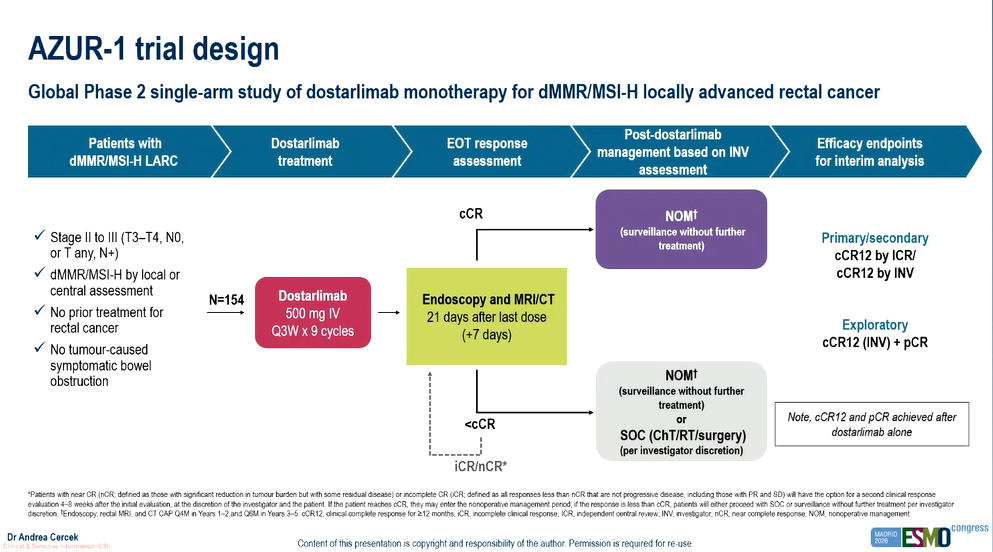
图1. AZUR-1研究设计
研究结果
截至数据截止日期(2026年4月20日),共纳入154例患者,中位随访时间为26.3个月(范围:2~36个月)。在144例随访时间≥12个月的患者中,68%达到cCR12(INV)。15例在多塔利单抗单药治疗后接受手术的患者中,12例(80%)达到pCR,cCR12+pCR率为76%(图2)。由于cCR是在初始治疗结束评估后由ICR进一步确认的,因此可由ICR评估cCR12的患者较少。在可由ICR评估的患者中,47%(54/116)达到cCR12,其中38例患者在DCO时处于cCR状态并正在接受cCR12随访。经研究者或独立中心评审评估,98%达到cCR的患者cCR≥12个月,迄今为止,达到cCR或pCR的患者均未出现复发。总体而言,93%的患者在治疗后(多塔利单抗±标准治疗)接受监测,未见疾病进展,其中71%的患者仅使用多塔利单抗就达到了这一结果。安全性良好:88%的患者完成了全部9个疗程的多塔利单抗治疗,4例患者发生了≥3级免疫介导不良事件。
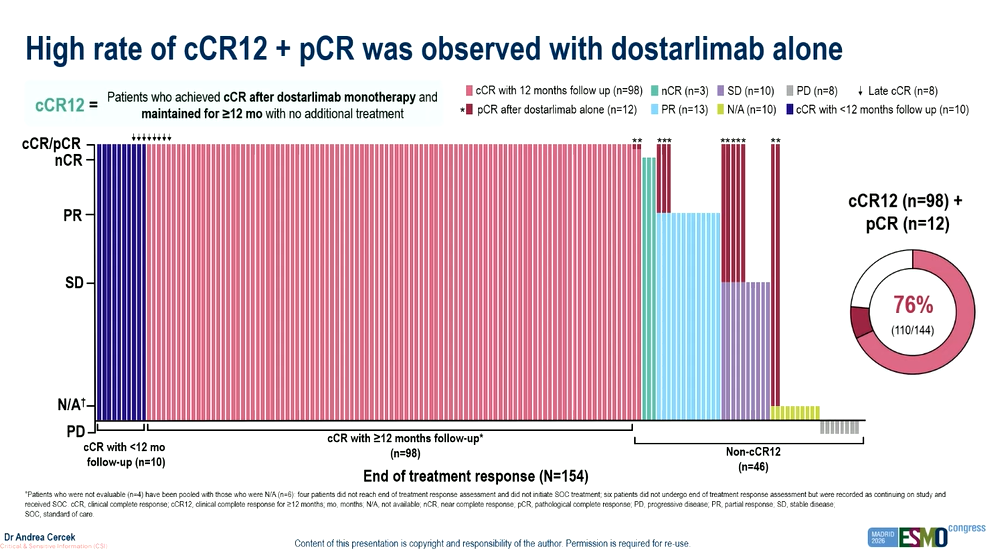
图2. AZUR-1研究结果
研究结论
在本次AZUR-1中期分析中,68%的患者使用多塔利单抗单药治疗后达到cCR12,76%的患者达到cCR12+pCR,且迄今为止未出现疾病复发。该持久缓解提示,该方案有望免去化疗、放疗及手术,重新定义dMMR/MSI-H LARC的根治性治疗模式。
· 专家介绍 ·
Andrea Cercek

美国纪念斯隆凯瑟琳癌症中心内科副教授
结直肠癌亚专业组负责人
早发性结直肠及胃肠道肿瘤中心联合主任
参考文献:[1] Cercek A, et al. N Engl J Med. 2022 Jun 23;386(25):2363-2376. [2] Cercek A, et al. 2026 ESMO. Abstract LBA87.[3] Cercek A, et al. Ann Oncol. 2026 Oct 25:S0923-7534(26)08070-1.
声明:本文仅供医疗卫生专业人士了解最新医药资讯参考使用,不代表本平台观点。该等信息不能以任何方式取代专业的医疗指导,也不应被视为诊疗建议,如果该信息被用于资讯以外的目的,本站及作者不承担相关责任。