
编者按:化疗是可手术胃癌患者围手术期治疗和不可手术胃癌患者一线治疗的标准方案,然而接受治疗的患者的生存期并不让人满意,在化疗的基础上做加法或改变治疗策略是当前正在探索的问题。免疫治疗为多个肿瘤的治疗带来了希望,改变了肝癌、肺癌等的治疗格局。免疫治疗是否能为胃癌患者带来更多获益是值得关注的话题,现介绍两项免疫药物分别治疗可手术和不可手术胃癌患者的研究。
可切除胃和胃食管交界处癌 (GC/GEJC) 中度伐利尤单抗加氟尿嘧啶、亚叶酸钙、奥沙利铂和多西他赛(FLOT)的病理完全缓解(pCR):全球III期MATTERHORN研究的中期结果
背景
全球3 期、随机、双盲、安慰剂(P)对照MATTERHORN研究(NCT04592913)在可切除GC/GEJC的患者(pts) 中评估围手术期度伐利尤单抗(D)和FLOT的疗效和安全性。现在报告预先计划的中期分析(IA)的结果。
方法
可切除(〉T2N0-3M0/T0-4N1-3M0)GC/GEJC的患者按1:1随机分配至第1天每4周(Q4W)D 1500 mg或P,加上第1天和第15天的FLOT Q2W持续4个周期(术前和术后2次D或P以及4次FLOT),然后Q4W第1天接受1500 mg D或P,再持续10个周期。IA是在所有随机患者接受手术或无法接受手术后进行的。通过中央审查(Modified Ryan)评估了pCR率(α=0.1% [2-side])的优越性。还评估了手术和安全性结果。
结果
每个治疗组随机分配474名患者。各组之间的基线特征是平衡的;各有19%的患者为亚洲患者。大多数患者患有GC(68%)、cT3(66%;cT4,25%)和cLN+(70%)。与P相比,在FLOT中添加D后观察到pCR具有统计学显著性改善(19% vs. 7%;Δ12%;比值比[OR],3.08;P<0.00001;表)。D组的综合pCR/接近完全病理缓解 (pnCR) 率为27%,P组为14%。接受手术的患者中,D组和P组的手术率(分别为87%和86%)和R0切除率(分别为 84% 和 86%)相似。新辅助治疗后降期上,更有利于D组(D vs. P为21% vs 10%,pT0;47% vs 33%,pN0;通过中央审查)。D和P暴露中位数相似。各组之间的不良事件发生率相似(表)。表:129O
在接受手术的患者中:D+FLOT,n=430,P+FLOT,n=422。†在安全分析集中:D+FLOT,n=475,P+FLOT,n=469。TRAE,治疗相关AE。
结论
在围手术期FLOT治疗中添加D,可切除GC/GEJC的pCR具有临床意义和统计学意义的显著改善,且安全性尚可。MATTERHORN研究正在进行中,以无事件生存为主要终点。
临床试验信息NCT04592913
帕博利珠单抗联合曲妥珠单抗和化疗治疗HER2+转移性胃或胃食管交界处(mG/GEJ)腺癌的III期、随机、双盲、安慰剂对照KEYNOTE-811研究
背景
在3期KEYNOTE-811研究的先前分析中,在前264名患者中,帕博利珠单抗 (pembro)/曲妥珠单抗和化疗(chemo)与安慰剂(pbo)/曲妥珠单抗和化疗相比,ORR分别为74%和52%。这些数据促使FDA批准一线pembro/曲妥珠单抗和化疗治疗HER2+mG/GEJ腺癌。现在提供预先指定的中期分析的结果。
方法
年龄≥18岁的一线、局部晚期不可切除或转移性HER2+ mG/GEJ腺癌(无论PD-L1表达水平如何)的合格患者 (pts) 按1:1随机分配至pembro 200 mg IV Q3W 或 pbo IV Q3W 加化疗(5- FU和顺铂 [FP]或卡培他滨和奥沙利铂[CAPOX]和曲妥珠单抗[SOC])。随机化按区域、PD-L1状态和化疗方案进行分层。治疗持续≤2年或直至疾病进展或出现无法耐受的毒性。双重主要终点是PFS(RECIST v1.1,BICR)或OS。本次中期分析的数据截止日期为2023年3月29日。
结果
在数据截止时,698名患者被随机分配(350 pembro + SOC;348 pbo + SOC)。中位随访时间为38.5个月。在所有患者中,pembro + SOC 与 pbo + SOC 相比显著改善了PFS(中位数 10.0 vs. 8.1个月;HR 0.73;95%CI:0.61-0.87;P=0.0002)。在PD-L1 CPS ≥1 的患者中,中位PFS为10.9个月 vs. 7.3个月(HR 0.71;95%CI:0.59-0.86)。在所有患者中,pembro+SOC 与 pbo+SOC 相比,OS均更长(中位数 20.0 vs. 16.8个月;HR 0.84;95%CI:0.70-1.01),以及PD-L1 CPS ≥1的患者(中位数 20.0 vs. 15.7;HR 0.81;95%CI:0.67-0.98)。由于未满足预先指定的显著性标准,OS继续进行最终分析。pembro + SOC与pbo + SOC的ORR分别为72.6% 和 60.1%(73.2%和58.4% [PD-L1 CPS ≥1]);中位DOR为11.3个月 vs. 9.5个月。≥3 级药物相关AE发生率分别为59%和51%。5级药物相关AE分别发生在4例(1%)和3例 (1%) 患者中。
结论
对于不可切除的HER2+mG/GEJ腺癌患者,尤其是PD-L1 CPS ≥1的患者,一线pembro加曲妥珠单抗和化疗可显著改善PFS,并改善ORR,且具有持久缓解。这些数据支持使用该方案作为HER2+和PD-L1阳性肿瘤的标准选择。
临床试验信息NCT03615326
摘要原文
129O - Pathological complete response (pCR) to durvalumab plus 5-fluorouracil, leucovorin, oxaliplatin and docetaxel (FLOT) in resectable gastric and gastroesophageal junction cancer (GC/GEJC): Interim results of the global, phase III MATTERHORN study
Background
The global, phase 3, randomised, double-blind, placebo (P)-controlled MATTERHORN study (NCT04592913) assesses perioperative durvalumab (D) with FLOT in participants (pts) with resectable GC/GEJC. Results of a pre-planned interim analysis (IA) are reported.
Methods
Pts with resectable (>T2 N0-3 M0/T0-4 N1-3 M0) GC/GEJC were randomised 1:1 to D 1500 mg or P every 4 weeks (Q4W) on Day 1 plus FLOT Q2W on Days 1 and 15 for 4 cycles (2 doses of D or P and 4 doses of FLOT pre- and post-operative), followed by D 1500 mg or P on Day 1 Q4W for 10 further cycles. IA was conducted after all randomised pts underwent or were precluded from surgery. Superiority of pCR rate (α=0.1% [2-sided]) by central review (Modified Ryan) was assessed. Surgical and safety outcomes were also assessed.
Results
There were 474 pts randomised to each treatment arm. Baseline characteristics were balanced between arms; 19% of pts in each enrolled in Asia. The majority of pts had GC (68%), cT3 (66%; cT4, 25%) and cLN+ (70%). A statistically significant improvement in pCR was observed with addition of D to FLOT vs P (19% vs 7%; Δ12%; odds ratio [OR], 3.08; p<0.00001; Table). Combined pCR/near-complete pathological response (pnCR) rate was 27% with D vs 14% with P. Surgery rate and R0 resection rate (in pts who underwent surgery) were similar with D (87% and 86%, respectively) vs P (84% and 86%, respectively). Downstaging favoured D vs P (pT0, 21% vs 10%; pN0, 47% vs 33%; by central review). Median D and P exposure was similar. Adverse event rates were similar between arms (Table). Table: 129O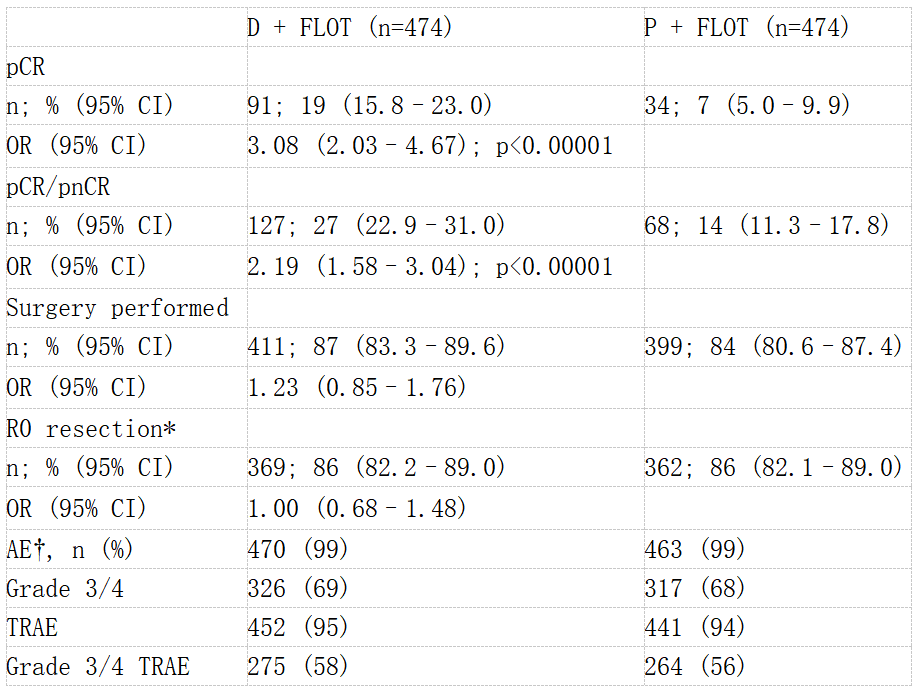
In pts with surgery: D + FLOT, n=430, P + FLOT, n=422. †In safety analysis set: D + FLOT, n=475, P + FLOT, n=469. TRAE, treatment-related AE.
Conclusions
The addition of D to perioperative FLOT therapy demonstrated a clinically meaningful and statistically significant improvement in pCR in resectable GC/GEJC, with a tolerable safety profile. The MATTERHORN study is ongoing for the primary endpoint of event-free survival.
Clinical trial identification
NCT04592913.
130O - The phase III, randomized, double-blind, placebo-controlled KEYNOTE-811 study of pembrolizumab plus trastuzumab and chemotherapy for HER2+ metastatic gastric or gastroesophageal junction (mG/GEJ) adenocarcinoma
Background
In a prior analysis of the phase 3 KEYNOTE-811 study, pembrolizumab (pembro)/trastuzumab and chemotherapy (chemo) vs placebo (pbo)/trastuzumab and chemo provided an ORR of 74% vs 52% in the first 264 pts. These data led to FDA approval of first-line pembro/trastuzumab and chemo for HER2+ mG/GEJ adenocarcinoma. We present results of a prespecified interim analysis.
Methods
Eligible patients (pts) aged ≥18 years with first-line, locally-advanced unresectable or metastatic HER2+ mG/GEJ adenocarcinoma irrespective of PD-L1 were randomized 1:1 to pembro 200 mg IV Q3W or pbo IV Q3W plus chemo (5-FU and cisplatin [FP] or capecitabine and oxaliplatin [CAPOX] and trastuzumab [SOC]). Randomization was stratified by region, PD-L1 status, and chemo choice. Treatment continued for ≤2 years or until disease progression or intolerable toxicity. Dual primary end points were PFS (RECIST v1.1, BICR) or OS. Data cut-off for this interim analysis was Mar 29, 2023.
Results
At data cut-off, 698 pts were randomized (350 pembro + SOC; 348 pbo + SOC). Median follow-up was 38.5 mo. In all pts, pembro + SOC vs pbo + SOC significantly improved PFS (median 10.0 vs 8.1 mo; HR 0.73; 95% CI 0.61-0.87; p=0.0002). In pts with PD-L1 CPS ≥1, median PFS was 10.9 vs 7.3 mo (HR 0.71; 95% CI, 0.59-0.86). OS was longer with pembro + SOC vs pbo + SOC in all pts (median 20.0 vs 16.8 mo; HR 0.84; 95% CI, 0.70-1.01), and in pts with PD-L1 CPS ≥1 (median 20.0 vs 15.7; HR 0.81; 95% CI, 0.67-0.98). As the prespecified criteria for significance was not met, OS continued to final analysis. ORR was 72.6% vs 60.1% with pembro + SOC vs pbo + SOC (73.2% vs 58.4% [PD-L1 CPS ≥1]); median DOR was 11.3 mo vs 9.5 mo. Grade ≥3 drug-related AE rates were 59% vs 51%. Grade 5 drug-related AEs occurred in 4 (1%) vs 3 (1%) pts, respectively.
Conclusions
First-line pembro plus trastuzumab and chemo significantly improved PFS, and improved ORR with durable responses vs pbo plus trastuzumab and chemo in pts with unresectable, HER2+ mG/GEJ adenocarcinoma, specifically in pts with PD-L1 CPS ≥1. These data support use of this regimen as a standard option for HER2+ and PD-L1-positive tumors.
Clinical trial identification
NCT03615326.
https://cslide.ctimeetingtech.com/asia2023/attendee/confcal/session/calendar