编者按:在结直肠癌(CRC)的免疫治疗领域,ADAR1作为一种重要的RNA编辑酶,近年来引起了广泛关注。来自中山大学肿瘤防治中心潘志忠教授团队的康达博士,在2024年欧洲肿瘤内科学会亚洲年会(ESMO Asia 2024)上分享了他们关于T细胞中ADAR1表达及其对结直肠癌免疫治疗影响的最新研究成果(摘要号:95P)。《肿瘤瞭望消化时讯》记者在大会现场邀请康达博士对该研究进行分享。
研究背景
ADAR1是一种RNA编辑酶,因其与干扰素(IFN)信号通路紧密相关,已在多种肿瘤中得到了广泛研究。然而,其在免疫细胞中的具体作用机制仍不明确。本研究探讨了ADAR1在不同类型细胞中的潜在生物学功能,为理解结直肠癌免疫治疗耐药性以及靶向T细胞中ADAR1表达的新型治疗策略提供了一定见解。
研究方法
研究团队通过多种生物信息学分析流程,从单细胞和组织转录组数据中获取了结直肠癌RNA编辑谱。具体分析方法包括基因功能富集、NMF聚类、RNA稳定性和单细胞相关性分析等,以全面探讨了ADAR1在不同细胞亚群中的影响。同时,研究团队通过流式细胞术(FC)、酶联免疫吸附法(ELISA)、免疫组化(IHC)和免疫荧光(IF)等实验方法,验证了ADAR1对T细胞的促耗竭作用及对免疫治疗的负向调控。
研究结果
研究表明,腺苷-肌苷(A-to-I)编辑在不同细胞类型中存在差异,提示ADAR1在CRC肿瘤异质性中发挥了重要作用(RNA编辑谱可聚类为4组)。生物信息学分析进一步证实,T细胞是CRC组织中ADAR1的主要来源,甚至一度高于肿瘤上皮细胞(基于EGA和GEO数据集)。ADAR1的表达水平与免疫应答的负向调控密切相关。临床样本显示,T细胞中ADAR1水平较高的患者在免疫治疗中获益较少(non-pCR患者T细胞中ADAR1表达水平更高),ADAR1促进了T细胞耗竭表型发生,并降低了其肿瘤杀伤活性,重塑了抑制性的肿瘤免疫微环境。
研究结论
本研究表明T细胞是CRC组织中ADAR1的主要来源,解析了T细胞表型对于免疫治疗预后的影响。这一发现为靶向T细胞中ADAR1的新型治疗策略提供了理论依据。
研究者说
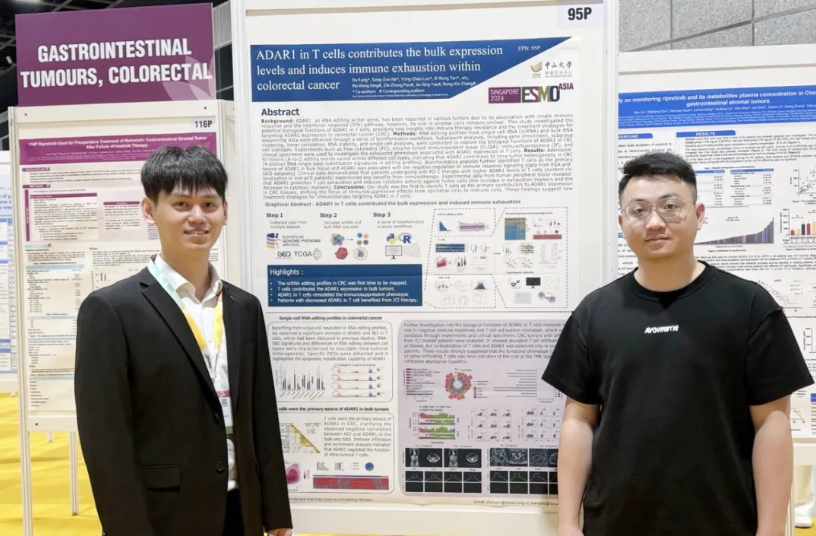
ESMO ASIA壁报展示现场照片
摘要原文
95P -ADAR1 of T cells rather than epitheliums contributes the bulk expression and induces immune exhaustion in colorectal cancer
Background
ADAR1, as an RNA editing writer, has been extensively studied in various tumors due to its strong correlation with the interferon response (IFN) pathway. However, its role in immune cells remains unclear. This study investigated the potential biological functions of ADAR1 across different cell types, providing new insights into immune therapy resistance and the potential of targeting ADAR1 expression in T cells for colorectal cancer (CRC) immunotherapy.
Methods
RNA editing profiles from single-cell and bulk transcriptome sequencing data were obtained through a series of bioinformatics workflows. Subsequent data analyses, including gene enrichment, NMF clustering, linear correlation, RNA stability, and single-cell related analyses, were conducted to explore the potential roles of ADAR1 in CRC cell subtypes. Experiments such as flow cytometry (FC), ELISA, xenograft models, immunohistochemistry (IHC), and immunofluorescence (IF) were used to investigate the negative regulation of the immune response by ADAR1 expression in T cells.
Results
Adenosine-to-inosine (A-to-I) editing events exhibited variations in different cell types, suggesting that ADAR1 contributed to the intra-tumor heterogeneity in CRC (4 clusters in editing profiles). Further bioinformatics analysis indicated that T cells, rather than epithelial cells, were the primary source of ADAR1 in CRC tissue (EGA, GEO datasets). ADAR1 expression was associated with the negative regulation of immune response signaling, and clinical data revealed that patients with higher ADAR1 levels in T cells benefited less from immunotherapy (pCR : non-pCR = 0.4 : 1.2). Experimental data from human samples showed that ADAR1 promoted T cell exhaustion and reduced cytotoxic activity against tumor tissues (Increase of exhausted markers in FC: 7% PDCD1, 19% TIGIT, 29% LAG3).
Conclusions
Our study firstly identified T cells as the primary contributors to ADAR1 expression in CRC tissues, shifting the focus of immunosuppressive effects from epitheliums to immune cells. This finding suggested new treatment strategies for immunotherapy targeting ADAR1 in T cells.
Legal entity responsible for the study
The authors.
Funding
Guangdong Basic and Applied Basic Research Foundation (Grant No. 2023A1515010243).
Disclosure
All authors have declared no conflicts of interest.
通讯作者简介
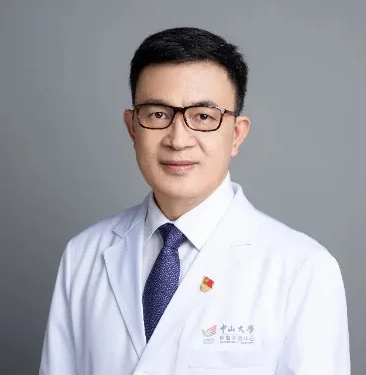
潘志忠 教授
医学博士、二级教授、一级主任医师、博士研究生导师,结直肠癌外科首席专家,中山大学肿瘤防治中心结直肠癌外科首席专家、结直肠科主任导师,2020年第四届国之名医·卓越建树,美国外科医师学会资深会员(Fellow of American College of Surgeons, FACS),中华结直肠癌MDT联盟常务主席,中国医师协会腹腔镜外科医师培训基地主任,中国医师协会肛肠医师分会肿瘤转移专业委员会副主任委员,中国医师协会肛肠医师分会大肠癌综合治疗专业委员会副主任委员,中国研究型医院学会肿瘤外科专业委员会副主任委员,中国医疗保健国际交流促进会消化肿瘤综合诊疗分会副主任委员,广东省健康管理学会肿瘤防治专业委员会副主任委员,广东省医疗行业协会微创外科管理分会副主任委员,广东省肿瘤性疾病质控中心结直肠癌专委会副主任委员。曾任:中山大学肿瘤防治中心结直肠科主任,广东省抗癌协会大肠癌专业委员会主任委员,中国抗癌协会大肠癌专业委员会第四、第五届副主任委员,中国抗癌协会大肠癌专业委员会肝转移学组组长,广东省医学会胃肠外科学分会副主任委员。承担国家级项目3项,省部级基金项目2项,发表专业论著200多篇。曾作为主要参与人分别获得中华医学会科技奖一等奖以及广东省科技进步奖一等奖。
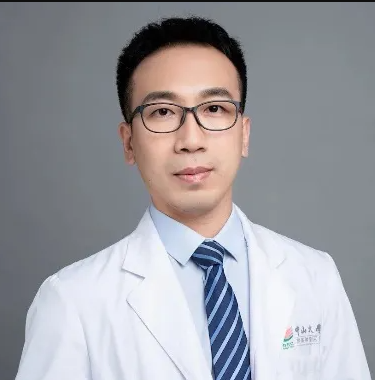
张荣欣 教授
医学博士、主任医师、硕士研究生导师。2012年毕业于中山大学并获得肿瘤学博士学位,并留院工作至今。2011年作为访问学者在香港大学医学院学习。2018年-2019年在美国宾夕法尼亚大学访学。主要的研究方向为结直肠癌的综合治疗,包括直肠癌的新辅助放化疗相关研究、结直肠癌免疫治疗以及结直肠癌发生和转移机制研究。目前在Ann Oncol, Clinical Cancer Res, Nat Cancer, Nat Commun. 等杂志发表论文10余篇。目前承担国家自然科学基金、广东省自然科学基金、中山大学优秀青年教师、中山大学肿瘤防治中心优秀科研导师项目等。
作者简介

康达 博士
潘志忠教授博士研究生,主要研究方向为结直肠癌综合治疗及免疫治疗相关机制。