肿瘤瞭望消化时讯

RESOLVE试验|与辅助CapOx相比,围手术期SOX治疗G/GOJ腺癌患者的5年生存率更高,且辅助SOX不逊于辅助CapOx

肿瘤瞭望消化时讯
编者按:在2023年欧洲肿瘤内科学会(ESMO)年会上,北京大学肿瘤医院张小田教授汇报了RESOLVE试验(摘要号:LBA78 )最新更新数据。与辅助CapOx相比,行D2胃切除术的G/GOJ(gastric or gastro-oesophageal junction,胃或胃食管结合部)腺癌患者围手术期接受SOX治疗的5年生存率更高,并且辅助SOX并不逊于辅助CapOx。


LBA78 - 围手术期或术后辅助奥沙利铂+S-1对比奥沙利铂+卡培他滨辅助治疗行D2切除术的局部进展期胃或胃食管结合部腺癌的总生存率:RESOLVE试验的最新分析


▌背景

RESOLVE研究表明,与辅助CapOx相比,接受D2胃切除术的胃或胃食管结合部(G/GOJ)腺癌围手术期接受SOX的患者可取得无病生存(DFS)获益。研究者更新了5年总生存率(5yOS%)结果。
图片

▌方法

III期、开放标签、随机对照RESOLVE研究(NCT01534546)纳入cT4aN+M0或cT4bNanyM0 G/GOJ腺癌患者。患者以1:1:1的比例随机分配到辅助CapOx、辅助SOX或围手术期SOX,并接受标准胃切除术和D2淋巴结切除术。辅助CapOx组接受8个周期奥沙利铂(130 mg/m2, d1)和卡培他滨(1000 mg/m2, bid, d1-14)。辅助SOX组接受奥沙利铂和口服S-1,剂量取决于体表面积(40—60mg bid, d1-14)。围手术期SOX组术前3个周期加术后5个周期再加3个周期S-1单药治疗。主要终点是3年DFS,次要终点包括5yOS%和安全性。
图片

▌结果

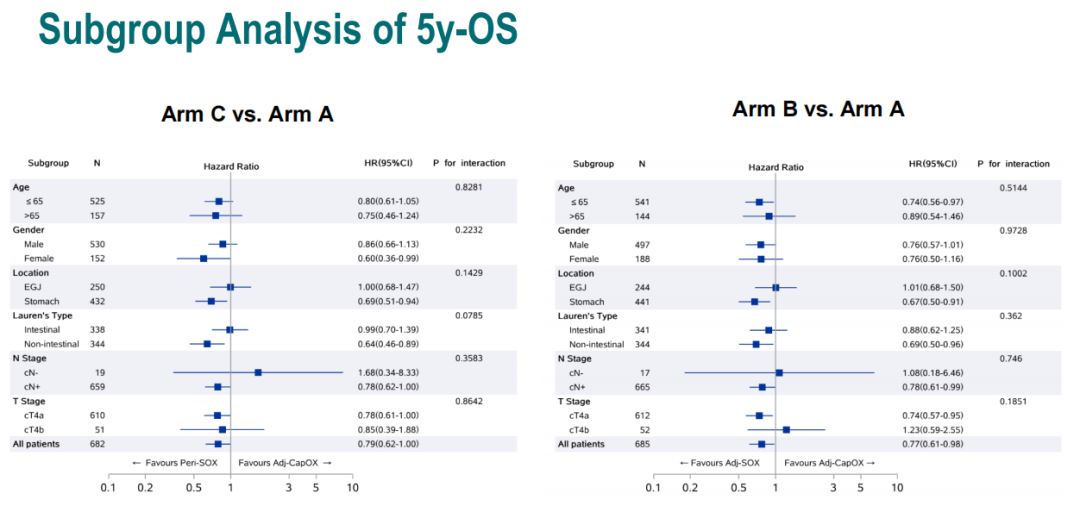
2012年8月至2017年2月,1022例患者纳入mITT人群并进行分析。中位随访时间为62.8个月,截至2022年4月7日,观察到495例复发和416例死亡。围手术期SOX较辅助CapOx改善5年OS% (60.0% vs. 52.1%;HR 0.79,95%CI:[0.62-1.00];P=0.049)。辅助SOX不低于术后CapOx (61.0% vs. 52.1%;HR 0.77,95%CI:[0.61-0.98];P=0.033)。与辅助CapOx相比,围手术期SOX改善5yDFS% (53.2% vs. 45.8%;HR 9, 95%CI:[0.63-0.98];P=0.034)。辅助SOX不亚于辅助CapOx(50.8% vs. 45.8%;HR 0.86,95%CI:[0.69-1.06];P=0.164)。未观察到其他不良事件。
图片


结论


最新的RESOLVE生存分析显示,与辅助CapOx相比,行D2胃切除术的G/GOJ腺癌患者围手术期接受SOX治疗的生存率提高,并且辅助SOX并不逊于辅助CapOx。
图片

摘要原文

LBA78 - Overall survival of perioperative or postoperative adjuvant oxaliplatin with S-1 versus adjuvant oxaliplatin with capecitabine in locally advanced gastric or gastro-oesophageal junction adenocarcinoma undergoing D2 gastrectomy: An updated analysis of RESOLVE trial

Speakers:Xiaotian Zhang (Beijing, China)

Background

The RESOLVE study demonstrated a disease-free survival (DFS) benefit from perioperative SOX compared to adjuvant CapOx in patients with gastric or gastro-oesophageal junction (G/GOJ) adenocarcinoma who underwent D2 gastrectomy. Here, we aim to update on the 5-year overall survival (5yOS%) results.

Methods

The phase III, open-label, randomized controlled RESOLVE study (NCT01534546) enrolled patients with stage cT4aN+M0 or cT4bNanyM0 G/GOJ adenocarcinoma. Patients were 1:1:1 randomly assigned to adjuvant CapOx, adjuvant SOX, or perioperative SOX and underwent standard gastrectomy with D2 lymphadenectomy. The adjuvant CapOx group received 8 cycles of oxaliplatin (130 mg/m2, d1) with capecitabine (1000 mg/m2, bid, d1-14). The adjuvant SOX group received oxaliplatin and oral S-1 at a dose depending on body surface area (40-60 mg bid, d1-14). The perioperative SOX group received 3 cycles of preoperative SOX plus 5 cycles of postoperative SOX followed by 3 cycles of S-1 monotherapy. The primary endpoint was 3-year DFS, and second endpoints included 5yOS% and safety.

Results

Between 08/2012 and 02/2017, 1022 patients were included in mITT population and analyzed. With a median follow up time of 62.8 months, 495 recurrences and 416 deaths were observed by 07/04/2022. Perioperative SOX improved 5yOS% compared with adjuvant CapOx (60.0% vs. 52.1%; HR 0.79, 95%CI [0.62-1.00]; p=0.049). Adjuvant SOX was not inferior to postoperative CapOx (61.0% vs. 52.1%; HR 0.77, 95%CI [0.61-0.98]; p=0.033). Perioperative SOX improved 5yDFS% compared with adjuvant CapOx (53.2% vs. 45.8%; HR 0.79, 95%CI [0.63-0.98]; p=0.034). Adjuvant SOX was not inferior to adjuvant CapOx (50.8% vs. 45.8%; HR 0.86, 95%CI [0.69-1.06]; p=0.164). No additional adverse events were observed.

Conclusions

The update on the RESOLVE survival analysis revealed improved survival in patients with G/GOJ adenocarcinoma undergoing D2 gastrectomy with perioperative SOX therapy compared to adjuvant CapOx, and adjuvant SOX was not inferior to adjuvant CapOx.

Clinical trial identification

NCT01534546.