
2026年美国临床肿瘤学会胃肠道肿瘤研讨会(ASCO GI)于2026年1月8~10日在美国旧金山盛大召开。作为全球消化肿瘤领域的顶尖学术盛会,大会旨在为全球肿瘤学者分享前沿研究成果、交流临床实践经验,传递该领域的最新进展与发展趋势。在ASCO GI 2026大会上,Hillary S Sloane博士汇报了一项题为“基于DYNAMIC研究中已接受结直肠癌切除手术的患者进行肿瘤知情MRD检测的可重复性与临床一致性分析”的研究(摘要号:26)[1]。研究结果显示,该检测在关键时间点具有高灵敏度与特异性,且在不同实验室间展现出极佳的可重复性。大会期间,《肿瘤瞭望消化时讯》邀请Hillary S Sloane博士围绕该研究成果分享前沿观点与研究思考。
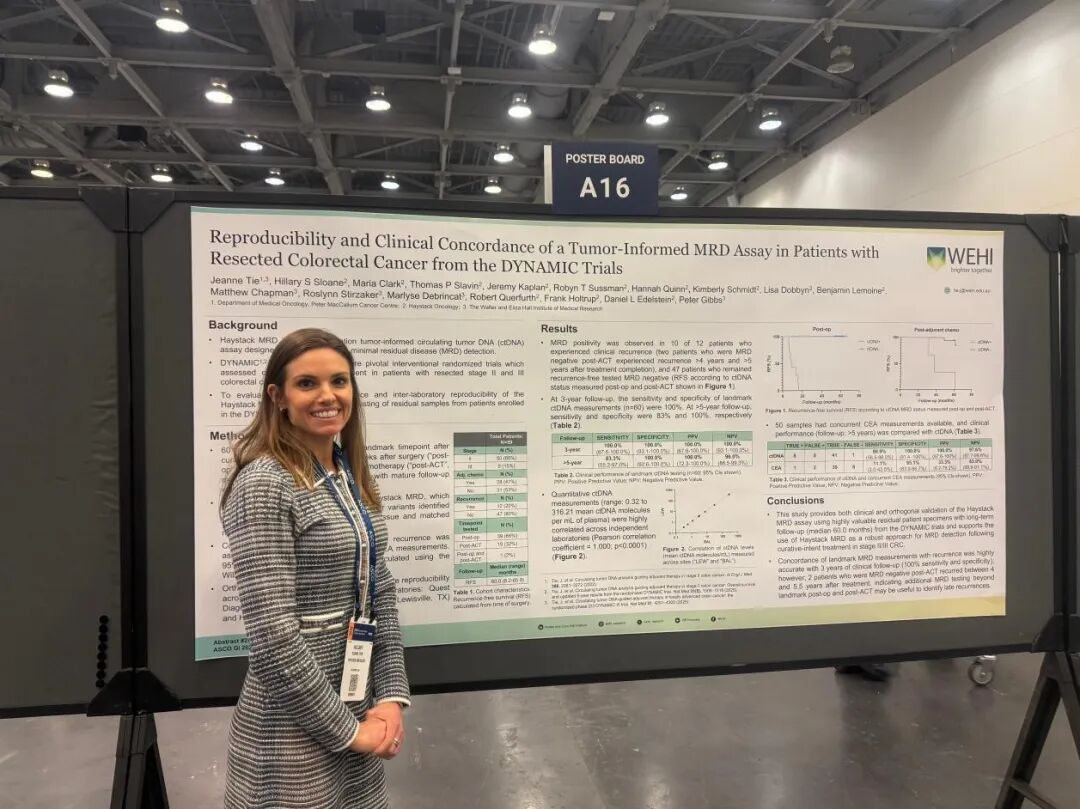
本次大会上,您带来了题为“基于DYNAMIC研究中已接受结直肠癌切除手术的患者进行肿瘤知情MRD检测的可重复性与临床一致性分析”的报告。能否请您分享其中的研究发现和核心见解。
Hillary S Sloane博士
好的。DYNAMIC研究(系列研究,包括DYNAMIC-Ⅱ和DYNAMIC-Ⅲ研究)是首个、也是迄今为止唯一完成的、将ctDNA作为核心干预性生物标志物的随机对照研究。研究将患者随机分为生物标志物指导组和标准治疗组。在生物标志物指导组中,若术后MRD检测为阳性,患者接受化疗;若MRD为阴性,则不进行化疗。结果显示,基于ctDNA的策略能更精准地筛选出需要治疗的患者,有效减少过度治疗,且不影响总生存期。DYNAMIC研究样本的优势在于拥有长期随访数据,并最终证实了其临床实用性。
该研究使用的检测技术源于约翰霍普金斯大学开发的学术性检测方法。该技术平台随后转化为商业化的检测产品,即Haystack MRD。如今,我们有机会获得DYNAMIC研究的剩余样本,并通过这一经优化迭代后实现商业化临床应用的Haystack MRD技术进行检测。现有样本均来源于关键时间点,即术后或化疗后的单次取样。研究发现,在为期3年的随访期内,60份样本的检测结果呈现出100%的灵敏度和特异性。但需要注意的是,有2例患者在治疗4~5年后才出现晚期复发。因此,若随访期少于5年,可能会漏检少数晚期复发病例。这提示对于晚期复发风险,进行后续随访检测可能是合理的。但重点在于,就单次时间点检测而言,目前尚未有其他技术能展现出与此相当的灵敏度。当前许多检测依赖多次连续测量来提升灵敏度表现,但本检测即使仅基于单次取样,仍具备足够的灵敏度,表现优异。此外,研究对其中50份样本同步进行了癌胚抗原(CEA)检测,实现对ctDNA与CEA的头对头性能比较。CEA虽被视为标准生物标志物,但其性能表现,尤其是与ctDNA相比,实际上较差。
Haystack MRD现已被Quest Diagnostics收购,目前已在临床中商业化应用,同时相关临床研究在巴尔的摩进行中。我们此次也验证了该检测在两地实验室的表现是否一致,并分析其中存在的差异。但总体来看,该检测在单时间点对此类人群的表现是稳定可靠的。
Dr. Hillary S Sloane:Okay, the DYNAMIC trials were the first and, to date,the only completed randomized interventional trials using ctDNA as an integral biomarker—as an interventional biomarker.So in the DYNAMIC trials, patients were randomized to a biomarker-driven group and a standard-of-care group. In the biomarker-driven group, after resection, if they were MRD-positive, they were treated with chemo; if they were MRD-negative, they were not treated with chemo. The trial showed that ctDNA can better select patients who need therapy and reduce overtreatment, with no difference in overall survival.The benefit of these samples is that there is long-term follow-up, and clinical utility was ultimately demonstrated.So the test used in the DYNAMIC trials was out of Johns Hopkins, an academic assay. The technology platform was then turned into a commercial assay called Haystack MRD. And so now we had the opportunity to have residual samples from the DYNAMIC trials and test them with this improved iteration of the technology called Haystack MRD that's now commercialized for clinical use.The samples that are available represent the landmark time point.So either one time point after surgery or one time point after chemotherapy. And what we show is that if you consider a 3-year follow-up, then among the 60 samples, we had 100% sensitivity and specificity. There were two patients who occurred late recurrences, so occurred more than 4 or 5 years after treatment.So if you consider the follow-up period is less than 5 years, you do miss a couple of patients. So I think just indicating that for late recurrences, follow-up testing is probably a good idea, but I think the point here is that we haven't seen with any other assay, this level of sensitivity with a single time point. We're seeing a lot of serial measurements that ultimately make the sensitivity look better. But if you consider a single time point, this assay is still sensitive enough to deliver really nice sensitivity. And then 50 of the samples had concurrent CEA measurements available. So we were able to compare the performance of ctDNA head-to-head with CEA. CEA is considered the standard-of-care biomarker but really has poor performance, especially compared to ctDNA.And then the Haystack MRD was bought by Quest Diagnostics. And so now it's commercially available through Quest, but it still runs in Baltimore for clinical studies. So we just wanted to show that the assay performs the same in both locations and to identify some of the discrepancies.But I think the performance in this population at a single time point is as it is.
肿瘤瞭望消化时讯
关于患者筛选,您采用何种标准来筛选可能从中获益的患者?
Hillary S Sloane博士
本次分析所使用的样本,均来源于DYNAMIC系列研究的剩余样本库,涵盖了针对Ⅱ期患者的DYNAMIC研究和针对Ⅲ期患者的DYNAMIC-Ⅲ研究。纳入研究的患者均符合根治性治疗标准,因此这批样本实质上代表了所有符合条件的入组人群。我们最终筛选出的这60份剩余样本,均来自那些在研究中留存了额外且充足生物材料的患者。总体而言,这些样本具有较好的代表性。
Dr. Hillary S Sloane:These were residual samples from the DYNAMIC trials—the initial DYNAMIC trial with stage two patients and DYNAMIC-Ⅲ with stage three patients. And it was just patients who were eligible for curative intent treatment. So really, all comers. The 60 residual samples really just represent the patients that had extra material on the trials. So it's basically just the ones that had a lot of material left over. It's really stage 2–3, kind of all comers undergoing curative intent treatment.
肿瘤瞭望消化时讯
您如何看待该方法在未来发挥的作用?您对其未来发展是否充满信心?
Hillary S. Sloane博士
从现有研究结果来看,该检测在关键时间点上具有可靠的参考价值。特别是在临床决策需要依赖生物标志物指导的关键时刻,这一表现尤为重要。事实上,能否依据单时间点检测结果指导治疗决策,一直是领域内关注的核心问题。因此,我们认为该检测方法具备良好的应用前景。对于后期复发的患者,随访检测仍然是必要的,但本研究结果进一步增强了我们对于该检测在同类应用场景中可靠性的信心。
Dr. Hillary S Sloane:I think the performance indicates that you can have confidence at the landmark time point. Really, when it matters, when you want to use the biomarker to inform management decisions, I think that's been a huge question in the field:can you rely on a single time point to inform decisions? So I think it is promising. And then I think for those patients who recur later, we do need to have follow-up testing, but I think it just provides confidence in this test in this application.
研究一览
摘要号:26
中文标题:基于DYNAMIC研究中已接受结直肠癌切除手术的患者进行肿瘤知情MRD检测的可重复性与临床一致性分析
研究背景:Haystack MRD是一种高精度、基于肿瘤知情策略的ctDNA检测方法,专为MRD检测而设计。为评估其临床性能和实验室间的可重复性,研究人员对入组DYNAMIC和DYNAMIC-Ⅲ研究的早期结直肠癌患者样本进行了回顾性检测。
研究方法:研究分析了来自59例具临床结局注释的患者(51例为Ⅱ期,8例为Ⅲ期结直肠癌)的剩余样本。检测采用经临床实验室改进修正案(CLIA)验证的Haystack MRD方法,该方法基于肿瘤组织与配对正常组织的全外显子测序,检测最多50个患者特异性肿瘤知情变异。检测对象为来自59例不同患者的60份游离DNA(cfDNA)样本,这些样本包含术后(N=40)和辅助化疗后(N=20)采集的血浆中中位数为3800个基因组当量。研究评估了MRD结果与临床复发的之间的一致性,并进行了正交验证,以评估两个独立CLIA认证实验室(德克萨斯州刘易斯维尔的Quest Diagnostics肿瘤卓越中心和马里兰州巴尔的摩的Haystack Oncology公司)之间的检测可重复性。
研究结果:两个实验室并行检测的所有60份样本在MRD结果上完全一致(一致率为100%)。在12例出现临床复发的患者样本中,有10例检测到MRD阳性;而在48例无复发生存的患者样本中,MRD检测均为阴性(灵敏度:83%;特异度:100%;阳性预测值[PPV]:100%;阴性预测值[NPV]:96%)。ctDNA定量测量值在0.32(最小值)至316.21(最大值)个平均ctDNA分子/毫升之间,且各实验室之间的检测结果高度相关(皮尔逊相关系数=1.000,P<0.0001),表明实验室间可重复性良好。其他检测仍在进行中。
研究结论:本研究使用来自DYNAMIC研究中特征明确的样本对Haystack MRD检测进行了临床和正交验证。结果显示,该检测方法与临床复发结局高度一致,且在独立实验室间具有良好的可重复性。这些发现支持将Haystack MRD作为Ⅱ/Ⅲ期结直肠癌根治性治疗后MRD检测的可靠方法,其有潜力指导辅助治疗决策,并实现基于ctDNA的主动监测。
摘要原文
Reproducibility and clinical concordance of a tumor - informed MRD assay in patients with resected colorectal cancer from the DYNAMIC trials.
Background:Haystack MRD is a highly accurate, tumor - informed ctDNA assay designed for minimal residual disease (MRD) detection. To evaluate clinical performance and inter - laboratory reproducibility, retrospective testing of samples from early - stage colorectal cancer (CRC) patients enrolled in the randomized DYNAMIC and DYNAMIC - III trials was performed.
Methods:Residual specimens from 59 patients (51 stage II, 8 stage III CRC) with annotated clinical outcomes were analyzed using the CLIA - validated Haystack MRD assay, which targets up to 50 tumor - informed, patient - specific variants derived from whole - exome sequencing of tumor and matched normal DNA. Testing was performed on 60 cell - free DNA (cfDNA) samples from 59 unique patients, containing a median of 3,800 genomic equivalents from plasma collected post - operatively (n = 40) and post - adjuvant chemotherapy (n = 20). Concordance of MRD results with clinical recurrence was assessed. Orthogonal validation was also conducted to evaluate reproducibility across two independent CLIA - certified laboratories: Quest Diagnostics Oncology Center of Excellence (Lewisville, TX) and Haystack Oncology (Baltimore, MD).
Results:All 60 samples tested with Haystack MRD in parallel at the two sites yielded concordant MRD results (100% agreement). MRD positivity was observed in 10 of 12 samples from patients who experienced clinical recurrence, while 48 samples from patients who remained recurrence - free tested MRD - negative (sensitivity: 83%; specificity: 100%; positive predictive value [PPV]: 100%; negative predictive value [NPV]: 96%). Quantitative ctDNA measurements were between 0.32 (min) and 316.21 (max) mean ctDNA molecules/ml and were highly correlated across sites (Pearson correlation coefficient = 1.000; p<0.0001), supporting strong inter - laboratory reproducibility. Additional testing is ongoing.
Conclusions:This study provides both clinical and orthogonal validation of the Haystack MRD assay using well - characterized specimens from the DYNAMIC trials. Results demonstrate high concordance with clinical recurrence outcomes and reproducibility across independent laboratories. These findings support the use of Haystack MRD as a robust approach for MRD detection following curative - intent treatment in stage II/III CRC, with potential to guide adjuvant therapy decisions and enable proactive, ctDNA - informed monitoring.
参考文献
[1].Hillary S Sloane, et al. ASCO GI 2026. Abstract:26.