
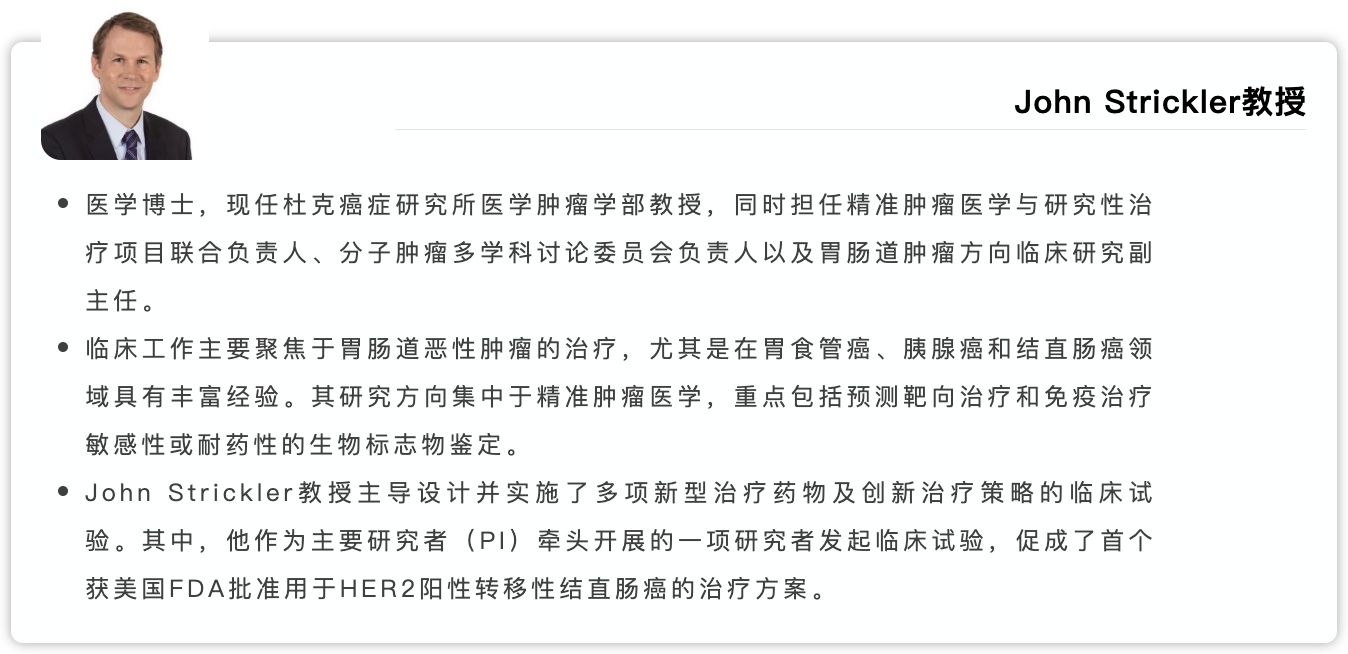
HER2阳性胃食管癌的治疗在过去十余年间经历了从单一靶向治疗到多策略联合的重要演进。随着免疫治疗与新一代HER2靶向药物的不断涌现,HER2治疗格局正进入快速迭代阶段。在2026年美国临床肿瘤学会胃肠道肿瘤研讨会(ASCO GI)会议上,杜克癌症研究所John Strickler教授报告“HER2靶向治疗胃食管癌的现状”。大会期间,《肿瘤瞭望消化时讯》邀请John Strickler教授围绕当前HER2靶向治疗在胃食管癌中的整体格局、尚未满足的临床需求以及未来发展方向分享前沿观点与研究思考。
肿瘤瞭望消化时讯
您如何评价目前HER2靶向治疗在胃食管癌领域的整体格局和临床定位?
John Strickler教授:HER2治疗格局正在经历显著演变。自曲妥珠单抗获批用于HER2阳性转移性胃食管腺癌的一线治疗以来,该领域在相当长一段时间内未出现实质性突破。直到在PD-L1阳性转移性胃食管腺癌患者中,将帕博利珠单抗联合化疗和曲妥珠单抗引入一线治疗,才带来了具有里程碑意义的进展。今年ASCO GI上公布的HERIZON-GEA-01研究数据进一步显示,在HER2阳性患者中,HER2双特异性抗体泽尼达妥单抗联合化疗的疗效优于曲妥珠单抗联合化疗。基于该研究结果,泽尼达妥单抗有望成为HER2阳性胃食管腺癌治疗中的又一项标准治疗选择。
Prof. John Strickler: The HER2 treatment landscape is under significant evolution. Following the approval of trastuzumab for the first line treatment of metastatic HER2+ metastatic gastroesophageal cancer, we waited nearly a decade for the next therapeutic breakthrough. The addition of pembrolizumab to chemotherapy and trastuzumab in patients with PD-L1 positive metastatic gastroesophageal cancer was a significant breakthrough. Now we have data from HERIZON-GEA-01 demonstrating that the anti-HER2 antibody zanidatamab is superior to trastuzumab when combined with chemotherapy in patients with HER2+ disease. Zanidatamab will likely become another standard of care option.
肿瘤瞭望消化时讯
尽管近年来HER2靶向治疗取得了一定进展,但在疗效持续性、耐药机制以及患者筛选等方面仍面临挑战。在您看来,目前HER2阳性胃食管癌治疗中最关键的未满足需求是什么?
John Strickler教授:尽管过去十年中取得了令人瞩目的进展,但绝大多数患者最终仍会出现疾病进展。我们仍需不断探索新的治疗策略,以帮助患者实现更长的生存并改善生活质量。目前抗HER2治疗在围手术期或根治性治疗阶段尚未形成明确定位。这也提示,在具有潜在治愈可能的患者中,仍存在进一步改善手术结局和长期生存的空间。目前已有一些小规模研究显示,抗HER2治疗及免疫治疗在围手术期应用中可取得较为积极的疗效。然而,这些结果仍需要通过更大规模、随机对照的Ⅲ期临床研究进一步验证。
Prof. John Strickler: Despite the impressive progress over the past decade, most patients eventually progress on treatment. We need to find new therapies to help our patients live longer and live better. Additionally, there is still no role for anti-HER2 therapies in the perioperative or curative setting. Clearly there is an opportunity to improve surgical outcomes and long-term survival for our patients with potentially curable disease. Already, there are small studies that have demonstrated good outcomes for anti-HER2 therapies and immunotherapies in the perioperative setting. These studies need validation in larger randomized phase III clinical trials.
肿瘤瞭望消化时讯
展望未来,您认为HER2靶向治疗在胃食管癌中的发展方向将主要集中在哪些方面?例如,新一代抗体、抗体偶联药物(ADC)或与免疫治疗的联合策略,哪些路径最值得期待?
John Strickler教授:我对目前正在研发中的多种新型治疗手段感到十分期待,包括酪氨酸激酶抑制剂、双特异性抗体、放射性配体治疗、免疫治疗以及ADC等。在这些治疗类别中,ADC因其展现出的疗效和良好的耐受性尤为令人期待;与此同时,也有一些新型免疫治疗策略同样显示出较大的发展潜力。
Prof. John Strickler: I am encouraged by novel therapeutics in development, including tyrosine kinase inhibitors, bispecific antibodies, radioligand therapies, immunotherapies, and antibody drug conjugates. Of these classes, I am particularly encouraged by the activity and tolerability of antibody drug conjugates, though there are also some novel immunotherapy strategies that hold promise.